
BSV Micropayments vs Lightning Network
Real-World Use Cases
The promise of micropayments — the ability to send fractions of a penny instantly, at scale, to anyone in the world — has been a recurring theme in cryptocurrency since Satoshi Nakamoto first described it in 2008. Two competing approaches now claim to have solved it. The evidence from live deployments tells a more nuanced story.
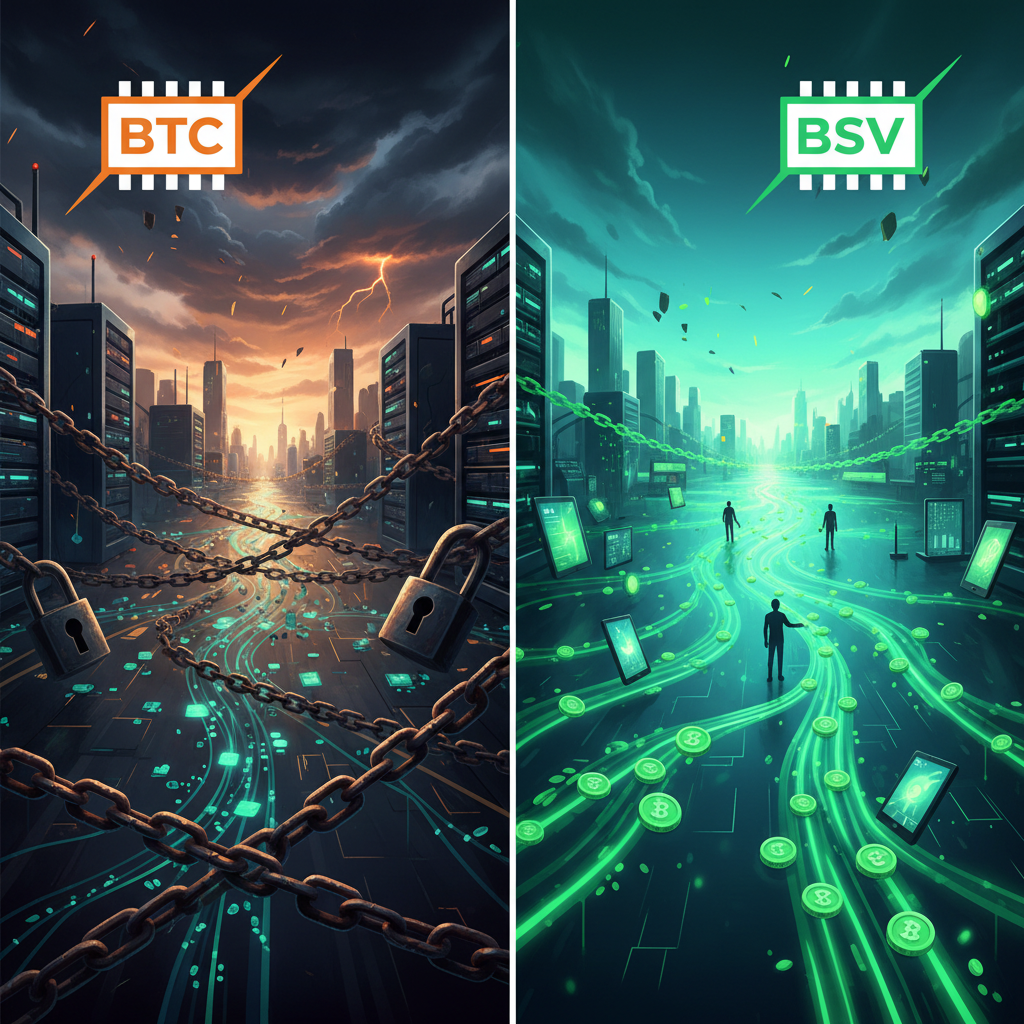
KEY DATA POINTS
- A micropayment costs $0.00001 USD on BSV — one thousandth of a cent. The same payment on BTC's base layer is economically impossible. On Lightning, it requires a pre-funded channel to the recipient.
- Opening a Lightning channel costs between $1.50 and $8.00 USD in on-chain BTC fees as of October 2026, depending on network congestion — a meaningful cost of entry for small businesses and creators.
- HandCash Connect processed over 10 million transactions as of its 2022 developer report — a figure that would be economically impossible on BTC's base layer and operationally complex on Lightning.
- Twetch demonstrates a use case Lightning cannot replicate at scale: a public social graph where every interaction is a micropayment to a potentially unknown recipient, with no prior channel relationship required.
- BSV's OP_RETURN payload allows a micropayment to simultaneously transfer value and record data — a timestamp, content hash, sensor reading, or licence key. Lightning payments leave no permanent on-chain record.
BITCOIN WHITEPAPER — ABSTRACT, FIRST SENTENCE
"A purely peer-to-peer version of electronic cash would allow online payments to be sent directly from one party to another without going through a financial institution."
Satoshi Nakamoto, 31 October 2008
What Is a Micropayment, and Why Does It Matter?
A micropayment is conventionally defined as a transaction below $1 USD. In practice, the most transformative micropayment use cases operate at the sub-cent level — payments of $0.001, $0.0001, or even smaller. At these amounts, the fee structure of the underlying payment rail is not a secondary consideration. It is the primary one.
If a payment costs $0.01 to process, you cannot profitably send $0.001. The fee exceeds the value transferred. This is not a hypothetical problem. It is the reason the internet has never had a native payment layer, why advertising became the dominant business model for digital content, and why billions of people remain excluded from financial services that require minimum transaction sizes.
Both BSV and Lightning Network claim to solve this. The evidence from live deployments tells a more nuanced story.
The Lightning Network: Architecture and Real-World Limitations
The Lightning Network is a second-layer protocol built on top of BTC. Rather than recording every transaction on the blockchain, it opens payment channels between parties, routes payments through a network of those channels, and settles the net result on-chain when a channel closes.
In theory, this allows near-instant, low-fee payments between any two parties connected through the network. In practice, several structural constraints limit its real-world utility.
Channel liquidity. To send a payment through Lightning, you must have a funded channel — or a route through other funded channels — to the recipient. If no adequately funded route exists, the payment fails. A 2023 analysis found that payments above approximately $200 USD had a meaningful failure rate due to liquidity constraints, and that routing fees increased non-linearly with payment size.
Inbound liquidity. To receive payments on Lightning, a node must have inbound liquidity — meaning another party must have locked funds in a channel pointing toward you. For new merchants or content creators, acquiring inbound liquidity requires either paying for a channel service or convincing a well-connected node to open a channel to them.
Channel management overhead. Channels must be opened and closed on-chain, incurring BTC transaction fees each time. As of October 2026, opening a Lightning channel costs between $1.50 and $8.00 USD in on-chain BTC fees depending on network congestion.
None of this makes Lightning Network useless. For specific use cases — particularly high-frequency payments between parties who already have established channels — it functions well. But the architecture imposes real constraints on who can use it, at what scale, and for what purpose.
BSV On-Chain Micropayments: Architecture and Real-World Performance
BSV takes a fundamentally different approach. Rather than moving payments off-chain, BSV scales the base layer itself. The protocol supports blocks with no hard size cap, enabling the network to process millions of transactions per second as miner infrastructure scales to meet demand.
As of October 2026, the median BSV transaction fee is approximately $0.00001 USD — one thousandth of a cent. A payment of $0.001 USD incurs a fee of roughly 1% of the transaction value. A payment of $0.01 USD incurs a fee of approximately 0.1%. These figures are stable and predictable, because BSV's fee market is not subject to the block space congestion that drives BTC fees upward during periods of high demand.
This fee structure is not theoretical. It is the foundation on which several live platforms have built real businesses.
Real-World Deployments: BSV Micropayments in Production
HandCash is a BSV wallet and developer platform that launched its first public version in 2019. HandCash allows users to send BSV to human-readable handles (e.g. $username) rather than cryptographic addresses, reducing the friction of peer-to-peer payments to a level comparable with Venmo or Cash App. HandCash Connect had processed over 10 million transactions as of its 2022 developer report — a figure that would be economically impossible on BTC's base layer.
Twetch is a social media platform built on BSV that launched in 2019. Its core mechanic is micropayment-native: every post costs $0.02 BSV to publish, every like costs $0.01 BSV, and a portion of those fees goes directly to the content creator. There are no advertisers. Revenue flows directly from readers to creators, mediated by the blockchain.
TonicPow is a BSV-native advertising protocol that launched in 2020. It replaces the traditional advertising model with direct micropayments from advertisers to promoters based on verified clicks and conversions. Payments are typically in the range of $0.01 to $0.10 per verified action, settled entirely on-chain.
PaiyBit is a BSV-native content monetisation platform that enables creators to gate digital content behind direct micropayments. A creator charging $0.10 per view across 1,000 views earns $100, with transaction fees totalling less than $0.10 across all payments. The same model on BTC's base layer would be economically unviable.
The Deeper Difference: On-Chain Data vs Payment Channels
BSV's micropayment architecture offers one capability that Lightning Network cannot replicate by design: the ability to attach data to a payment. Every BSV transaction can carry an OP_RETURN payload of arbitrary data, allowing a micropayment to simultaneously transfer value and record information — a timestamp, a content hash, a sensor reading, a licence key.
This is the foundation of Certihash's Sentinel Node product, which uses BSV transactions to create an immutable audit trail of network security events. Each event costs a fraction of a cent to record permanently on-chain. The payment and the data are inseparable.
Lightning Network payments are off-chain by design. They leave no permanent on-chain record until a channel closes. For use cases where the audit trail matters — compliance, data notarisation, supply chain verification — this is a fundamental limitation.
Conclusion
Lightning Network is a genuine engineering achievement that solves a real problem for a specific set of use cases: high-frequency payments between parties with established channel relationships, particularly where both parties are online and technically capable of managing node infrastructure.
BSV's on-chain micropayment architecture solves a different and broader problem: enabling any party to send any amount to any other party, at any time, with no prior relationship, no channel management, and no infrastructure requirement beyond a standard wallet.
The platforms that have built on BSV — HandCash, Twetch, TonicPow, PaiyBit, and others — are not theoretical demonstrations. They are live products with real users, real transactions, and real revenue flowing directly between creators and their audiences. That is the promise Satoshi described in 2008. On BSV, it is already being delivered.
A Direct Comparison: Specific Use Cases
| Use Case | BSV On-Chain | Lightning Network |
|---|---|---|
| Pay-per-article ($0.005) | Viable. Fee ≈ $0.00001 | Viable if channel exists |
| Social media tip to unknown user ($0.01) | Viable. No prior relationship needed | Requires routing path to recipient |
| IoT machine-to-machine ($0.0001) | Viable. Devices transact directly | Channel setup cost exceeds use case value |
| Advertising micropayment to publisher ($0.05) | Viable. Many-to-many, on-chain | Requires complex liquidity management |
| High-frequency gaming ($0.001 × 10,000/day) | Viable. Each tx settles on-chain | Viable within a channel; settlement cost applies |
| Cross-border remittance ($50) | Viable. Single on-chain transaction | Viable; Lightning performs well at this size |